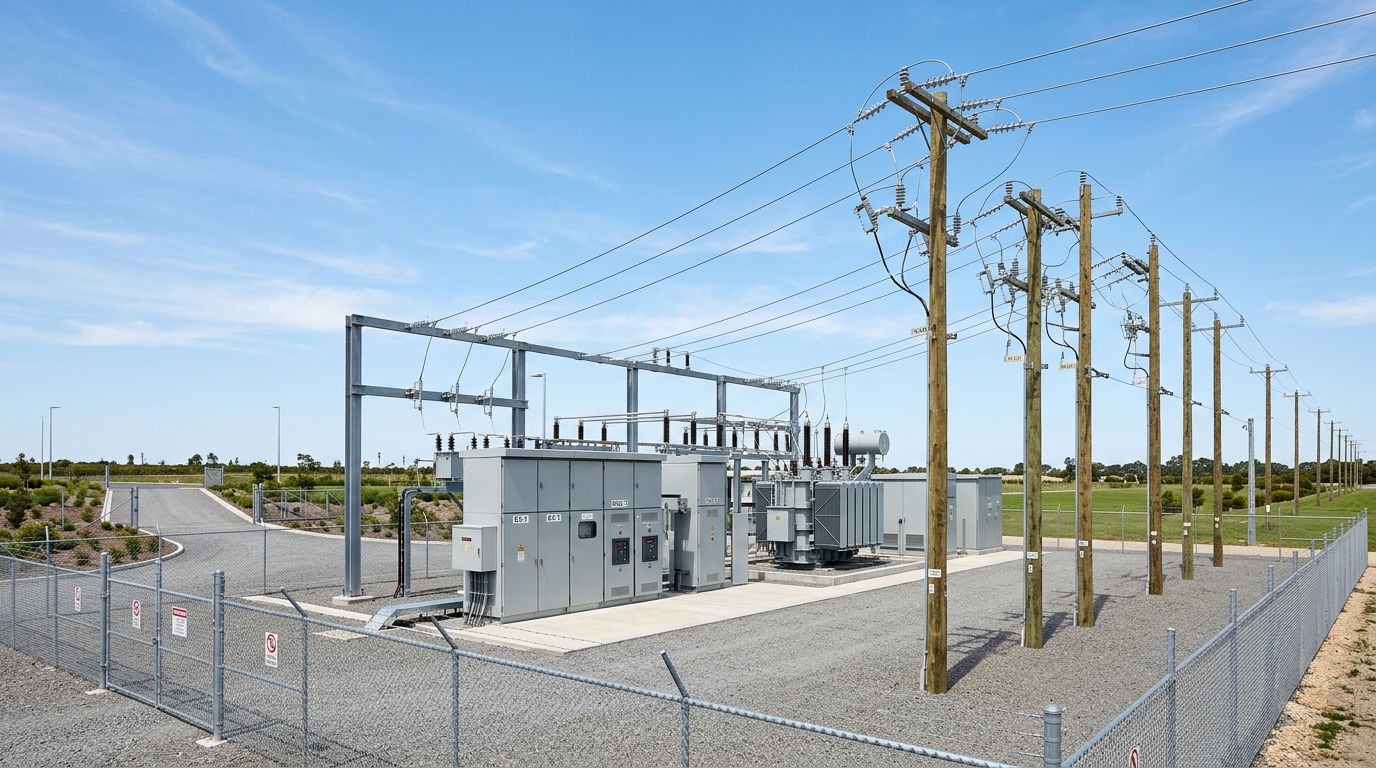
OUR FEEDER MONITORING UNIT GATEWAY & ALARM SURVEILLANCE

FMU Gateway stands for Feeder Monitoring Unit Gateway. It is designed to wirelessly collect operational data from multiple Feeder Monitoring Units (FMUs), actively supervise their communication status and power health, and reliably backhaul telemetry, alarms, and alerts to backend utility servers via GSM / APN, LAN, or NB-IoT.
Core Engineering Pillars

Wireless FMU Data Collection

Wirelessly collects operational data from multiple Feeder Monitoring Units (FMUs) across distribution feeder lines with robust RF communication links.

Communication Status Monitoring

Continuously tracks the communication status of each connected FMU to instantly identify whether a unit is communicating normally or offline.

Comprehensive Alarm Tracking

Monitors critical grid events including Communication Drop Alarms, Power ON restoration alarms, and Power OFF outage alarms in real time.

Multi-Network Server Backhaul

Transmits consolidated data and alerts to backend servers at user-configured push intervals via GSM/APN, Substation LAN, or NB-IoT.

Dual-Role Operational Architecture

Bridges field-level feeder devices with centralized enterprise utility platforms by combining local wireless collection with long-range secure wide-area backhauling.

Engineered for rugged 24/7 deployment across electrical substations, distribution panels, and pole-mounted utility enclosures, Mirach FMU Gateway empowers utilities with real-time feeder visibility and proactive outage management.
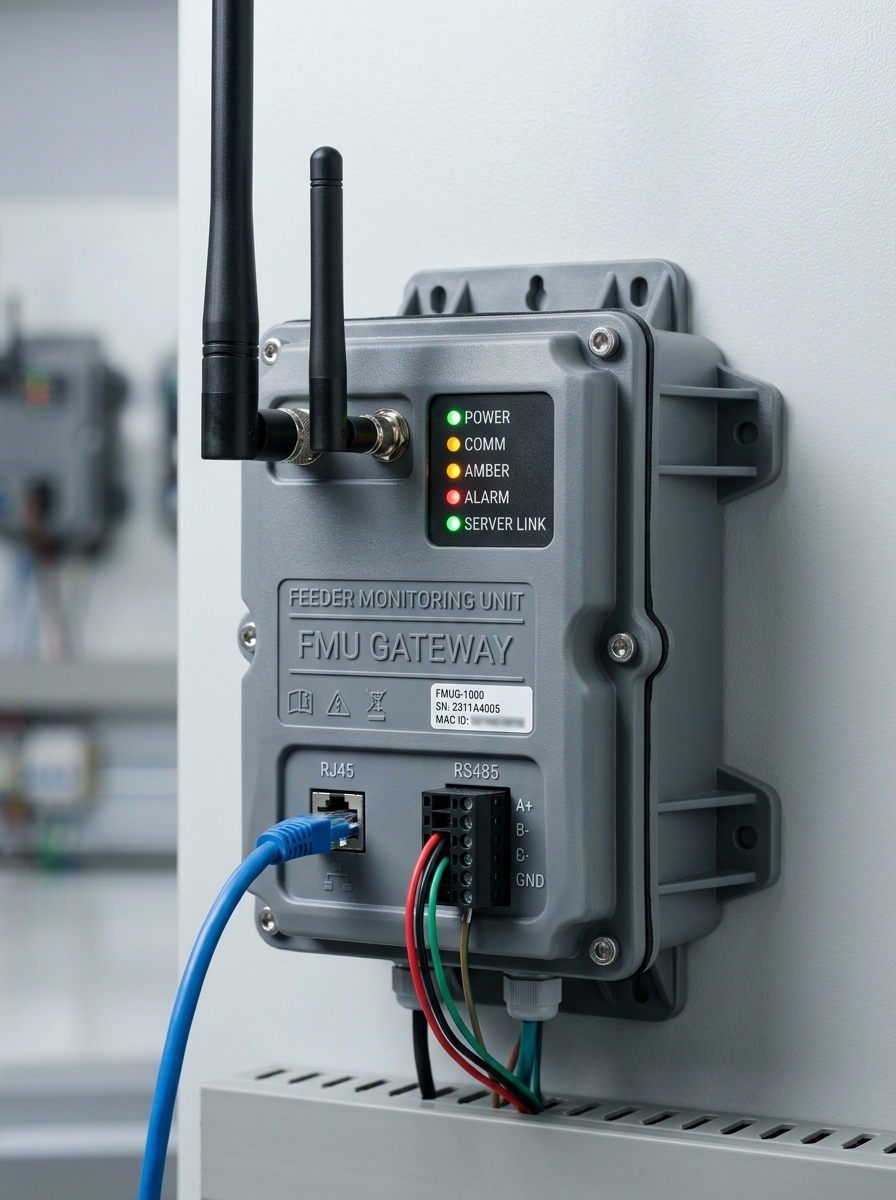
FMU Gateway — Centralized Feeder Monitoring with Active Status & Alarm Surveillance.

FMU Gateway Hardware Enclosure

Two Key Functions: FMU-Side & Server-Side Communication

A dual-architecture operational model designed for complete feeder network transparency

1. FMU-Side Communication

Field Data Collection & Link Supervision

Collects operational telemetry wirelessly from multiple Feeder Monitoring Units across the local network, establishing resilient RF communication channels and performing continuous status surveillance:

  • Multi-FMU Ingestion: Concurrently acquires telemetry from all deployed feeder monitoring units.
  • Active Link Heartbeats: Detects whether each FMU is actively transmitting or disconnected.
  • Alarm Polling: Rapidly registers power interruption, restoration, and telemetry fault flags.
Wireless RF Ingestion Heartbeat Telemetry Multi-Feeder Mesh

2. Server-Side Communication

Secure WAN Backhaul & Cloud Dispatch

Consolidates collected FMU data, power transition events, and alarm notifications, reliably dispatching them to centralized utility enterprise servers at configurable intervals:

  • Cellular GSM / APN: Dedicated private APN connectivity for high-security utility networks.
  • Substation LAN: Wired Ethernet connectivity directly into substation control switches.
  • NB-IoT Low Power: Narrowband cellular for deep penetration and bandwidth optimization.
GSM / APN Wired LAN RJ45 NB-IoT LPWAN

End-to-End System Communication Flow

From electrical feeder sensors to centralized utility enterprise backend

1

Feeder Units (FMUs)

Multiple FMUs installed along power distribution lines sample electrical currents, voltages, and feeder operating states.

Distribution Feeders Line Telemetry
2

Wireless Transmission

FMUs stream operational data wirelessly across RF links to the gateway, maintaining active heartbeat checks.

Wireless RF Heartbeat Link
3

Gateway Aggregation

FMU Gateway tracks communication availability, parses line metrics, and logs critical power transition events.

Status Tracking Alarm Aggregation
4

Server Push & HES

Consolidated data packets push to backend Head-End Systems (HES) over GSM/APN, LAN, or NB-IoT at set intervals.

HES Integration Configured Push

Alarm Surveillance & Technical Specifications

Industrial-grade feeder monitoring parameters, alarm classifications, and hardware standards

Comprehensive Alarm & Alert Matrix

  • ● Communication Alarm: Triggered immediately when wireless communication with any FMU is lost or unavailable.
  • ● Power ON Alarm: Generated when a monitored FMU powers up or recovers from a distribution feeder outage.
  • ● Power OFF Alarm: Generated instantly when an FMU experiences power failure or supply shutdown for rapid fault localization.
  • ● Operational Alerts & Events: Captures and dispatches user-defined telemetry anomalies, phase deviations, and threshold alarms.

Technical & Environmental Specifications

  • System Type: Feeder Monitoring Unit Gateway
  • FMU Wireless Interface: Multi-Node RF Wireless Link
  • Server Backhaul Options: GSM / APN, LAN (Ethernet), NB-IoT
  • Data Push Cadence: Configurable Interval / Event-Driven
  • Enclosure Protection: IP65 Rugged Industrial Polycarbonate
  • Operating Temperature: -40°C to +85°C Substation Grade

Utility Deployment Scenarios & Grid Reliability Impact

Ensuring uninterrupted power delivery, rapid fault isolation, and regulatory compliance across distribution networks

Outage Management

Automated Fault Localization & Faster Restoration

When line faults or phase trips occur along distribution feeders, the FMU Gateway instantly captures and broadcasts Power OFF alarms with millisecond-accurate timestamps. Dispatch teams identify and isolate damaged feeder sections in minutes rather than hours, drastically lowering utility SAIDI and SAIFI indices.

Millisecond Timestamps Instant Fault Trip Alarms SAIDI / SAIFI Optimization
Grid Optimization

Dynamic Phase Balancing & Capacity Surveillance

Continuous interval telemetry of voltages, active currents, and reactive power loads across multiple feeder nodes prevents distribution transformer overloading during peak hours. Utilities accurately diagnose phase imbalances and defer costly capital substation upgrades with real-time field data.

Phase Unbalance Alarms Transformer Asset Protection Peak Load Tracking
Hardware Engineering

Substation-Grade Ruggedization & Retrofit

Engineered with an IP65 polycarbonate housing, 6kV surge suppression, conformal PCB coating, and wide -40°C to +85°C thermal tolerance, the FMU Gateway easily retrofits inside existing Ring Main Units (RMUs), feeder pillars, and outdoor switchgear panels without expensive architectural redesigns.

IP65 Weatherproof 6kV Surge Withstand RMU / Pillar Integration
Cybersecurity & Uptime

Private APN Isolation & Zero Telemetry Loss

Field data is secured using mutual cryptographic authentication, TLS-encrypted backhaul, and dedicated private APN tunneling. An integrated hardware watchdog and local non-volatile flash buffer ensure uninterrupted communication monitoring and zero telemetry loss during transient network dropouts.

Private APN Tunneling Hardware Watchdog Local Flash Buffer